Source-defined validation command
python -m unittest discover -s tests -vObserved in .github/workflows/markdown-maintenance.yml:L39
Native source materials / 20 indexed
This index links to repository-authored course records, examples, tutorials, and technical reading. The separate browser lab is an educational surrogate; its sliders and checkpoints do not execute this repository's native engine.
Current audited native source: b76ca31619dd2b2c8fe2e15b9bb1a53453aa3fa1
Browser-lab provenance from the reconciled package: package source revision 573e04d53ee0cc06f17d9984c432daad2e7bf5e6. This is separate from the current native source revision above.

These exact one-line commands were observed in the audited repository workflow records and link to their source location. Expected setup, tool licensing, data, and environment vary by repository; the dashboard does not execute these commands or promise a completion time.
Source-defined validation command
python -m unittest discover -s tests -vObserved in .github/workflows/markdown-maintenance.yml:L39
20 materials

Use this template for public paper or technical-report notes. Do not copy copyrighted text; summarize in your own words.
references/reading-log-template.md

Battery thermal models should use the simplest heat-generation representation that can answer the engineering question without hiding important operating-condition effects.
notes/heat-generation-model-selection.md
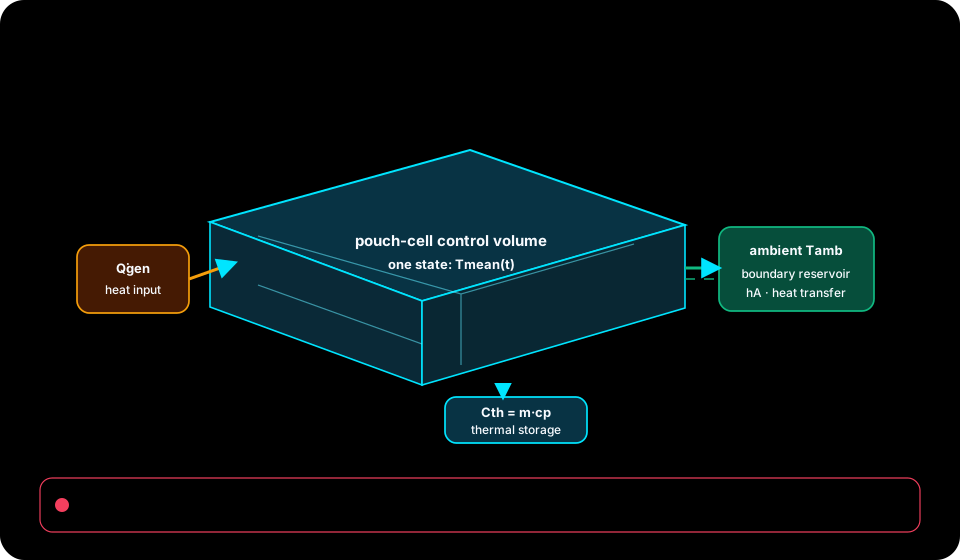
This dependency-free Python model turns the repository's simplest documented
models/README.md
Title: Li-Ion Battery Thermal Characterization for Thermal Management Design
references/reading-log-nrel-li-ion-thermal-characterization.md
Research-backed notes and reproducible examples for battery thermal behavior,
README.md

Battery thermal management system (BTMS) choices should be compared against the operating profile, packaging constraints, service model, safety concept, and validation evidence available for the project.
notes/btms-architecture-comparison.md
Use this note as a compact example for reporting thermal model results with enough context for review. Values below are placeholders and should be replaced with project, lab, or literature-backed data.
notes/thermal-validation-example-result-summary.md

This note captures assumptions that should be stated before presenting battery thermal simulation results.
notes/modeling-assumptions.md
Use this page for recording the assumptions used when cell-level thermal behavior is scaled to module or pack level. It helps keep battery thermal modeling notes explicit about sources, assumptions, limits, and validation impact.
notes/cell-to-pack-scaling-note.md
Use this page for comparing passive, air, liquid, and hybrid thermal management options at concept level. It helps keep battery thermal modeling notes explicit about sources, assumptions, limits, and validation impact.
notes/cooling-strategy-trade-study.md
Use this page for mapping the path from cell heat generation to the final heat sink in thermal notes. It helps keep battery thermal modeling notes explicit about sources, assumptions, limits, and validation impact.
notes/heat-rejection-pathway-map.md
Use this page for extracting source-backed thermal claims from public literature without losing context. It helps keep battery thermal modeling notes explicit about sources, assumptions, limits, and validation impact.
references/literature-claim-extraction-template.md
Use this page for capturing the next public-literature and validation questions raised by thermal notes. It helps keep battery thermal modeling notes explicit about sources, assumptions, limits, and validation impact.
references/research-next-questions-log.md
Use this page for documenting why temperature limits were selected and what evidence supports them. It helps keep battery thermal modeling notes explicit about sources, assumptions, limits, and validation impact.
notes/temperature-limit-rationale-note.md
Use this table as a compact example for documenting battery thermal model assumptions before sharing plots, simulation results, or design claims.
notes/thermal-assumptions-example-table.md
Early-stage battery thermal models are useful for learning, screening, and review conversations, but their limits should be stated before results are used for design decisions.
notes/thermal-model-limitations.md
Use this page for stating what thermal runaway topics are inside or outside a modeling note or analysis. It helps keep battery thermal modeling notes explicit about sources, assumptions, limits, and validation impact.
notes/thermal-runaway-scope-boundary.md
Use this guide to rank confidence in battery thermal sources before using them to support a BTMS claim, validation result, or modeling assumption.
notes/thermal-source-confidence-guide.md
Use this page for clarifying whether thermal results represent transient behavior or steady-state conditions. It helps keep battery thermal modeling notes explicit about sources, assumptions, limits, and validation impact.
notes/transient-vs-steady-state-guide.md
Use this page for choosing model validation metrics that match the thermal claim and available evidence. It helps keep battery thermal modeling notes explicit about sources, assumptions, limits, and validation impact.
notes/validation-metric-selection-guide.md